
5. Their Mission
Each woman, on either side of the discussion,
held within her motivations and a mission which spurned her decision to pick
her battle. Their reasons for opposition varied with each individual and were
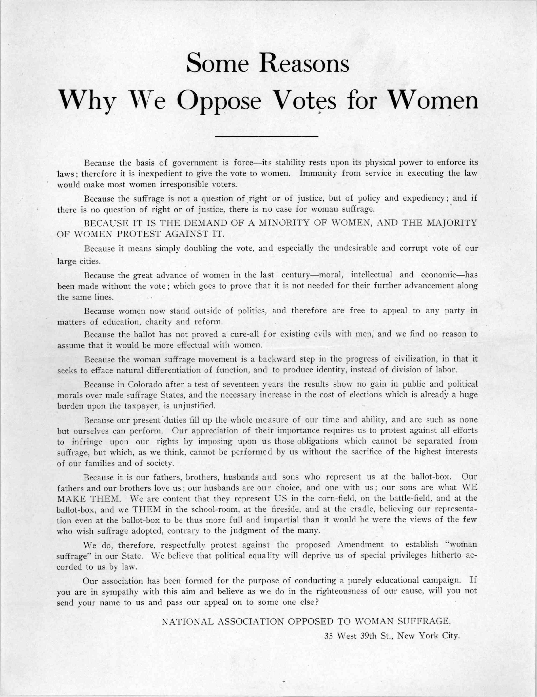
laid out plainly in the NAOWS’s declaration of Some Reasons Why We Oppose Votes for Women published in 1894. Some
felt that women could not be responsible voters as they were disallowed the opportunity
to be agents of the government through the military or law enforcement.[1]
Others had a fundamental disagreement against the idea that those in support of
Women’s Suffrage merely wanted to double the voting capacity of the major
cities acting as an additional vote to their husband, or even nullifying his
vote should she disagree.[2]
Elaborating on that same line of objection, many felt that the system was
already broken with male participation and that adding women to the mess would
only hurt the cause rather than contribute to its repair.[3]
Then there was the ethical dilemma that women already had enough to do in their
daily lives that adding one more responsibility of educated voting would render
the right an obligation, “our appreciation of their importance requires us to
protest against all efforts to infringe upon our rights by imposing upon us
those obligations which cannot be separated from suffrage…”[4]
The NAOWS concluded their manifesto by stating that their male counterparts “…represent
us at the ballot box. Our fathers and our brothers love us; our husbands are
our choice; and one with us; our sons are what WE MAKE THEM.”[5]
Further defending their willingness to abdicate their right to vote by stating,
“We are content that they represent US in the corn-field, on the battle-field,
and at the ballot-box, and we THEM in the school-room, at the fireside, and at
the cradle.”[6] Moral arguments also
breeched the surface including a severe concern against the Suffrage Movement’s
support of Margaret Sanger and her ideals about birth control and planned
parenting, placing the right of reproduction in the hands of the woman rather
than the right of the family.[7]
 |
| SOURCE |
[1] National
Association Opposed To Woman Suffrage. Some reasons why we oppose votes
for women ... National association opposed to woman suffrage. New York City.
New York, 1894. Pdf. https://www.loc.gov/item/rbpe.1300130c/.
[2] Ibid 1
[3] Ibid 1
[4] Ibid 1
[5] Ibid 1
[6] Ibid 1
[7] "Margaret Sanger and the Women's Suffrage
Movement." CSUN Oviatt Library. September 18, 2018. Accessed April 28,
2019. https://library.csun.edu/SCA/Peek-in-the-Stacks/sanger.